
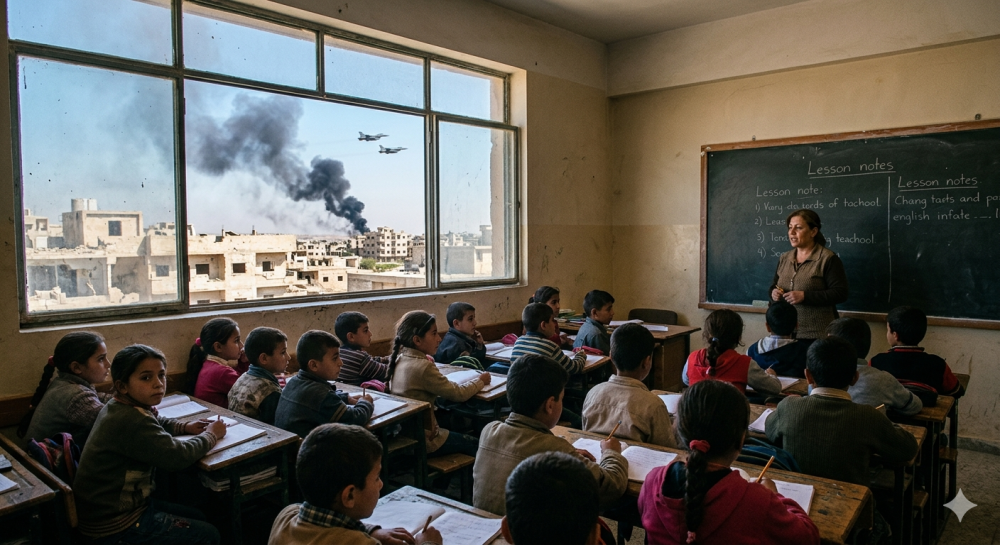
The world is experiencing turmoil and unrest locally, regionally, and globally. The situation is severely affecting human life socially, mentally, emotionally, and psychologically. The values, principles, and laws that were once upheld as standards of human dignity now appear to be treated with far less respect than they deserve. In the chaotic and unpredictable situation, the most suffering segment of society is children and their education. Conflict is one of the most destructive forces affecting education systems, because it does not merely interrupt schooling temporarily; it erodes the foundations on which learning depends. When war, civil unrest, displacement, or political violence enter society, schools cease to be safe spaces and become vulnerable institutions struggling to function amid fear, loss, and instability. The effects are visible at every level: children drop out, teachers flee or are killed, classrooms are damaged, families lose livelihoods, and governments redirect scarce resources from education to security and emergency response. In this sense, conflict is not only a humanitarian crisis but also an educational crisis that undermines human development for generations.
The first and most immediate impact of conflict is the disruption of access to schooling. Schools are often closed, occupied, destroyed, or rendered inaccessible due to insecurity. Even where they remain open, attendance becomes irregular because families are displaced, transportation is unsafe, or children are forced into labor to support household survival. Girls are often disproportionately affected, facing increased risks of early marriage, exploitation, and gender-based violence. For many children in conflict settings, the school trajectory is broken early and permanently, creating a lost generation of learners who may never return to formal education. This is not simply a matter of missed lessons; it is a denial of a child’s right to learn, grow, and participate in society.
Beyond access, conflict severely damages the quality of learning. Learning requires concentration, emotional security, regular instruction, and stable relationships with teachers and peers. In conflict-affected environments, children often experience trauma, grief, hunger, anxiety, and chronic fear, all of which reduce cognitive functioning and make learning difficult. Teachers, too, are affected by the same conditions: they may be displaced, demoralized, underpaid, or professionally unsupported. As a result, instruction becomes inconsistent, curriculum coverage declines, and assessment systems weaken. Even when children remain enrolled, they frequently learn far less than their peers in stable contexts, widening educational inequality and reinforcing long-term disadvantages.
Conflict also weakens the education system itself. Ministries of education lose administrative capacity, budgets shrink, infrastructure deteriorates, and data systems become unreliable. Policies that depend on long-term planning become difficult to implement when the state is focused on survival rather than reform. Teacher training slows, school supervision becomes limited, and resource distribution becomes fragmented. Over time, the system may become dependent on humanitarian aid rather than public investment, creating parallel structures that may be necessary in the short term but unsustainable in the long term. This is why conflict should be understood not only as a temporary disruption but as a structural threat to the entire education ecosystem.
The social consequences are equally serious. Education in stable societies helps build social cohesion, civic values, and hope for the future. In conflict settings, however, education can become divided along ethnic, sectarian, religious, or political lines, further deepening mistrust and exclusion. If children grow up without shared spaces for learning, dialogue, and cooperation, societies become more vulnerable to future cycles of violence. In this way, conflict undermines education, and weakened education can, in turn, sustain and intensify conflict. The relationship is reciprocal: peace supports learning, and learning supports peace.
Despite these realities, it is important to argue that education must not be treated as a secondary concern during conflict. On the contrary, education is one of the most strategic investments in fragile contexts because it protects children, preserves hope, and lays the foundation for recovery. Emergency education, accelerated learning, psychosocial support, flexible school calendars, teacher incentives, and community-based learning models can help sustain access when formal systems collapse. But these responses must be accompanied by stronger commitments to peacebuilding, protection of schools, and long-term system reconstruction. Education in conflict settings should not be limited to survival; it should be designed to restore dignity, continuity, and opportunity.
The strongest argument, therefore, is that conflict is not merely an obstacle to education; it is a direct attack on a society’s future. When children are denied safe, continuous, and meaningful learning, the consequences extend far beyond the classroom. They shape labor markets, governance, social cohesion, gender equality, and national reconstruction for decades. A society that allows conflict to destroy its schools is not only losing education today; it is sacrificing the possibility of peace and prosperity tomorrow. For this reason, protecting education in conflict must be treated as both a moral imperative and a political priority.